


24 Sep What’s Cracking?
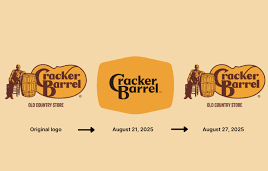
…I mean “Old Country Store” is… errr WAS right in the logo..
Cracker Barrel’s logo change was supposed to be a simple refresh — instead, it cracked open a full-blown customer revolt. In a world swimming with data, the brand still misread its base, sparking backlash, falling traffic, and a scramble to roll it all back.
What Went Down
In August 2025, Cracker Barrel unveiled a new, simplified logo — one that dropped their longtime mascot “Uncle Herschel,” the overalls-leaning man leaning on a barrel, and stripped away the “Old Country Store” phrase. Forbes+3AP News+3Investopedia+3
The change was part of a broader modernization push: remodeled interiors in some test restaurants, lighter décor replacing their traditional Americana clutter, and updated branding intended to appeal to newer, younger consumers. Forbes+3The Guardian+3Business Insider+3
But backlash was immediate and vicious. Longtime customers — especially in conservative/generational demographics — saw it as erasing heritage, becoming “woke,” or abandoning identity. Trump himself tweeted support for the old logo. Business Insider+7Reuters+7Politico+7
Traffic declined ~8% after the change, versus a baseline drop of just ~1% earlier in the month. The Washington Post+3Reuters+3AP News+3
Shares also dipped — the stock dropped about 3% immediately, and the company had to revise its revenue outlook downward. Investopedia+3Reuters+3Investopedia+3
Within days, Cracker Barrel reversed the rebrand. They restored the original mascot/logo, paused further remodeling, and said they’d halt the modernization rollout. Investopedia+4AP News+4The Guardian+4
The CEO later publicly admitted they underestimated how emotionally attached customers were to the old branding. New York Post+2Forbes+2
Why It Blew Up
1. They misread their core customer
Cracker Barrel is a brand built on nostalgia, tradition, “Old Country Store” Americana, and longstanding middle-America identity. Removing the mascot and simplifying the logo erased the visual memory people used to emotionally connect with the brand.
When your audience cares deeply about symbols — your logo, your décor, your “look and feel” — those aren’t superficial details. They are part of the promise. Cracker Barrel’s leadership appears to have misjudged how much those visual assets contributed to loyalty.
2. They ignored data they already had
In 2025, brands have tons of customer data: loyalty program metrics, surveys, foot traffic segmentation, sentiment on social media, historical preference analysis, segmentation by region/demographic.
This wasn’t a brand with no signal — many indicators (like declines vs. competition, feedback on decor) likely flagged risk points. Instead of small experiments or phased rollouts with heavy testing, they rolled a big change and expected it to land.
3. Poor rollout + weak communication
The new logo was introduced in the fourth paragraph of a fall menu announcement. That signals low prioritization. AP News+1
They didn’t adequately prepare to defend the move, show the rationale, or ease customers in. Instead, the brand shift felt abrupt and opaque.
4. Political polarization + cultural risk
In 2025, nothing is purely aesthetic. In a hyper-polarized environment, brand changes get weaponized. Cracker Barrel’s shift was seized by political voices, turning a design decision into a cultural flashpoint. The Washington Post+3The Guardian+3Politico+3
That means brands like Cracker Barrel don’t just contend with design risk — they face identity risk, community backlash, and amplified criticism by media and political actors.
Repercussions & What’s At Stake
-
Traffic loss & sales hit — an 8% drop in foot traffic, weaker revenue, downgraded forecasts. AP News+2Investopedia+2
-
Stock value damage — share price fell, and investor confidence was shaken. Investopedia+2Reuters+2
-
Brand trust erosion — customers who feel betrayed by change may not return.
-
Cost of reversal — you don’t just stop; you undo. Signage, marketing, remodeling, PR — all sunk cost.
-
Missed opportunity cost — the money and energy spent on modernizing could have been invested in product, service, menu innovation.
-
Strained identity — what is Cracker Barrel now if not the classic icon? They risk becoming captive to nostalgia rather than evolving with culture.
What They Could (and Should) Do Now
-
Re-anchor in what worked: return to décor, menu, values, and aesthetic customers love.
-
Do smaller, test-based innovation in adjacent areas (kitchen, operations, menu) instead of rebranding core identity.
-
Lean into storytelling — show the rationale, bring the customers into the narrative.
-
Use segmentation: maybe test a modern logo only in certain markets, paired with classic alternative options.
-
Monitor social & sentiment rigorously, lean fast on feedback.
-
Be humble in tone: admit misstep, show you’re prioritizing customers more than design ego.
m2 Take
The Cracker Barrel rebrand flop is a reminder: when you bet against your base — for aesthetic or modernization reasons — you risk everything they once loved.
In a world where customer sentiment is tracked in real time, brand shifts are no longer bold strokes — they’re surgical plays. If you lose your emotional anchor, your brand becomes untethered.
Cracker Barrel’s mistake wasn’t wanting to modernize — it was assuming modernization outweighs memory. The brands that survive are those whose core customers feel seen, not sidelined.