


03 Oct The Digital Reaper and the Age of Synthetic Politics

From Television to Twitter to AI: How Trump Is Rewriting the Rules of Political Spectacle
In American politics, every medium eventually becomes the message.
In the 1960s, television remade the presidential campaign into a visual drama, forever memorialized in the Kennedy-Nixon debates, where sweat and five o’clock shadow may have cost Nixon the White House. In the 2010s, Twitter turned politics into real-time spectacle, a gladiator’s arena where brevity and outrage often carried more weight than policy.
Now, in the mid-2020s, we are entering a new chapter — one where artificial intelligence, deepfakes, and synthetic media are no longer sideshow novelties but central to the political arsenal. And, as so often before, Donald Trump is the one rewriting the rules of engagement.
Act I: Don’t Fear the Reaper
The curtain rose with a clip that defies simple description.
On Truth Social, Trump released an AI-generated video featuring a skeletal Grim Reaper — the face of former OMB Director Russ Vought — scything down bureaucrats and enemies of the administration. The soundtrack: a retooled version of Blue Öyster Cult’s “(Don’t Fear) The Reaper.”
The Daily Beast called it “bizarre.” Critics labeled it dystopian. But the message was unmistakable: in the age of meme warfare, allegory is more powerful than argument. The Grim Reaper doesn’t invite debate. It seizes the imagination, bypassing cognition to lodge in the gut.
Act II: The Expanding AI Arsenal
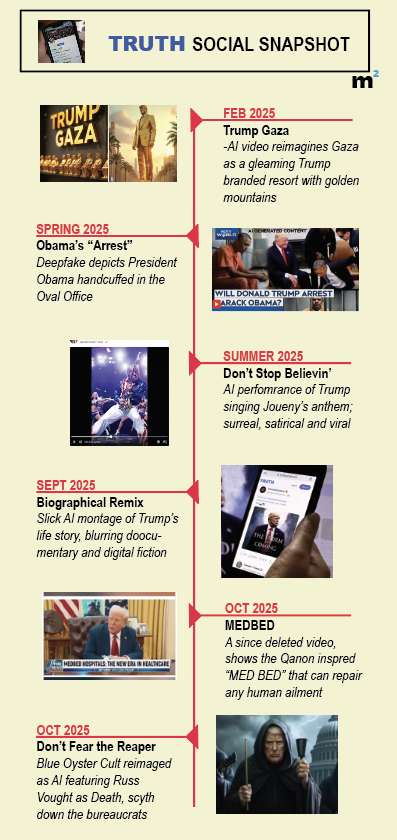
The Reaper video is just the latest installment in a growing catalog of Trump’s AI-generated content:
-
“Trump Gaza”: Gaza reimagined as a golden Trump-branded resort, complete with luxury hotels and beachfront vistas.
-
Obama’s Arrest: A fabricated video depicting Barack Obama in handcuffs, paraded as though the impossible were inevitable.
-
The Biographical Remix: A stylized AI video animating Trump’s life story as a cinematic arc.
-
“Don’t Stop Believin’”: An AI avatar of Trump performing Journey’s anthem, surreal and satirical in equal measure.
Each of these creations works on the same logic: they operate less as statements of fact than as shortcuts to myth. They are digital parables for the faithful, delivered in a medium that cannot be fact-checked before it is shared, digested, and believed.
Act III: The Generals’ Parade
Then came Quantico.
Defense Secretary Pete Hegseth convened nearly 800 generals and admirals for what should have been a sober policy briefing. Instead, it became a rally.
He derided “fat generals,” mocked “beardos,” and promised to reinstate rigid discipline. New York Post gleefully published the speech in full. The audience’s response, however, was muted. According to Washington Post, applause lines landed flat, silences lingered.
It was a tableau of dissonance: a civilian-led military rally more focused on optics than operations, obedience than strategy. Where television once gave us Camelot and Twitter gave us chaos, AI now gives us authoritarian aesthetics — a stage where the military itself becomes a prop.
Act IV: The Cracks Appear
But even spectacles have consequences.
Speaker Mike Johnson Breaks Ranks
On the House floor, Rep. Madeleine Dean accused the president of being “unhinged” and “unwell.” Speaker Mike Johnson didn’t deny it. Instead, he muttered, “A lot of folks on your side are too. I don’t control him.”
Daily Beast
For the man third in line to the presidency, this was not a gaffe. It was a fracture — the acknowledgement, however oblique, that the president’s behavior was cause for concern. Johnson even admitted one of Trump’s AI videos was “not my style.” Daily Beast
Pritzker’s Call for the 25th
Illinois Governor J.B. Pritzker went further. When Trump suggested using Chicago as a “training ground” for military exercises, Pritzker responded with fury:
“Thinking that cities are battlefield training grounds is, frankly, inane. There is something genuinely wrong with this man.”
Yahoo News
His conclusion: invoke the 25th Amendment. Rep. Eric Swalwell quickly echoed the call in a blunt tweet: “25TH AMENDMENT!”
The spectacle, once the province of Trump alone, now provokes counter-spectacles: calls for removal, public shaming, even whispered talk of incapacity.
Act V: A Nation Being Edited
The deeper danger here is not just Trump, but the medium itself.
Television once created the presidency-as-image. Twitter created the presidency-as-feed. Now AI is creating the presidency-as-simulation — a mediated reality in which imagery and myth race ahead of law, fact, and governance.
The risks are structural:
-
Speed outpaces scrutiny. Fact-checks arrive after the narrative has already gone viral.
-
Spectacle substitutes for substance. Discipline is reduced to haircut policies, governance to meme-able imagery.
-
Guardrails strain under pressure. When the Speaker of the House says the president is “unwell,” and a governor demands his removal, institutional legitimacy itself begins to fray.
m2 Take: What Does This Mean?
For brands, leaders, and institutions, the lesson is stark: synthetic media is no longer the future of communication — it is the battlefield of the present.
-
Narratives travel faster than truth. AI-enabled spectacle bypasses fact, embeds myth, and dominates perception. If you’re not setting the frame, you’re already behind it.
-
Optics are strategy. Leaders who dismiss the visual economy as superficial miss the point: appearance is authority in a world edited at scale.
-
Trust is the last competitive edge. In a marketplace of illusions, credibility is currency. Brands and institutions that consistently act with transparency and humanity will be the ones people anchor to.
-
Preparation beats reaction. Don’t wait to be caught flat-footed by a viral fabrication. Anticipate narratives, scenario-plan responses, and build resilience now.
The convergence of AI, politics, and spectacle isn’t a sideshow. It’s a preview of how every brand, every leader, and every institution will soon be judged — not just by what they do, but by the synthetic realities built around them.
The reaper has arrived. The question isn’t whether you fear it. It’s whether you’re ready to master it.