


16 Oct (kinda-sorta) Freedom of the press.
The Pentagon vs. the Press: Why This Moment Matters
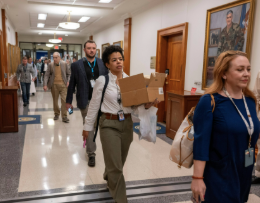
In mid-October 2025, nearly all journalists covering the U.S. Department of Defense relinquished their press badges and vacated their Pentagon offices.
The trigger was a new Pentagon policy under Defense Secretary Pete Hegseth requiring reporters to sign a 21-page agreement. Under the rules, the Department could revoke badges if journalists sought certain classified or some unclassified information without prior clearance.
Major outlets refused to sign, citing a threat to press freedom and government transparency. The list includes:
Reuters, Associated Press, Bloomberg, The New York Times, The Wall Street Journal, The Washington Post, CNN, Fox News, ABC, CBS, NBC, NPR, Axios, Politico, The Atlantic, The Guardian, Newsmax, Breaking Defense, Task & Purpose, and The Washington Times.
The press corps packed up their equipment and left, leaving the once bustling Pentagon press room empty.
What the Pentagon Says — and What They’re Trying to Sell
Pentagon spokesperson Sean Parnell defended the policy as necessary for national security. He argued that the agreement doesn’t force reporters to agree in principle — it requires them to acknowledge the rules. The Department maintains this is a “common sense” adjustment to how sensitive information is handled.
🔗 Reuters
However, critics say that distinction is semantic: reporters see the rule as a constraint, not merely acknowledgment. The Pentagon Press Association called the move “a blow to free speech and accountability.”
🔗 Reuters+1
Some Pentagon officials have said the restrictions align with practices at other military installations and are part of broader efforts to secure controlled architecture around press access.
🔗 TIME+1
What the White House and Trump’s Position Have Been
At the White House, President Trump publicly backed Hegseth’s new rules. He defended them by suggesting the press is “very disruptive” and “very dishonest.”
🔗 AP News+2https://www.wowt.com+2
When questioned about whether the Pentagon should have control over press reporting, Trump responded, “Nothing stops reporters,” implying that while regulation might exist, it should not stifle journalism.
🔗 Politico
Some observers interpret his statement as equivocal — a rhetorical stance intended to deflect criticism without explicitly rescinding support for the new access policy.
🔗 Politico
White House press officials have echoed the national security framing, asserting that restricting sensitive military reporting is part of responsible governance — not censorship.
What’s at Stake
Erosion of Oversight
As press access is constrained, scrutiny over defense decisions, military operations, funding, and errors becomes harder. The press is a central accountability mechanism; reducing access weakens that check.
Precedent for Controlled Narratives
If institutions can require compliance before granting access, transparency becomes contingent on loyalty. The “authorized press” model threatens to rewrite whose questions get asked — and whose don’t.
Shift in Information Power
Mainstream media pulling out vacates the field for controlled outlets or narrative channels aligned with the administration. That shifts what stories get told, how, and by whom.
Trust and Legitimacy Risk
When defense institutions restrict who can report on them, public confidence erodes. In an era of skepticism, limiting visibility toward power rarely builds credibility.
M2 Take
The Pentagon’s press crackdown is more than a moment in media — it’s a recalibration of power. When the government limits who can see — and who can ask — the machinery operates in shade, not sunlight.
The White House’s posture — backing the rules while framing pushback as “disruption” by the press — underlines the core gambit: doubt the messenger, not the message.
In a time when every institution is under question, defending the right to observe matters more than ever. When transparency retreats, power advances.