


22 Oct Three’s company… but is this a crowd?
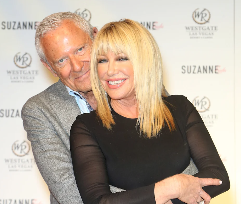
Suzanne Somers and Alan Hamel: Love, Legacy, and the AI Afterlife
For nearly five decades, Suzanne Somers and Alan Hamel were Hollywood’s most quietly enduring couple — partners in both life and enterprise. She was the radiant sitcom star who turned wellness entrepreneur, and he the Canadian television host who became her business partner, manager, and unwavering confidant. Together, they built a multimillion-dollar empire around health, longevity, and lifestyle — a brand powered as much by her charisma as by their shared vision of eternal youth.
When Somers died in October 2023, just one day shy of her 77th birthday, Hamel was devastated — but not defeated. In a gesture equal parts devotion and futurism, he began building what he calls her “AI twin”: a digital recreation of Suzanne designed to think, speak, and respond like the woman he loved.
Now, through a mix of archived video, published writings, and advanced neural modeling, Alan Hamel is bringing his wife back to life — not as a ghost, but as an evolving artificial presence that he says is “indistinguishable” from the real Suzanne.
What it is

Hamel revealed that the project—dubbed the “Suzanne AI Twin”—was both conceived by Suzanne herself and built with the assistance of companies like Realbotix Corp and Hollo.AI. Page Six+2New York Post+2
According to Hamel, the AI model has been trained on:
-
All 27 of Suzanne’s books. EW.com
-
Hundreds of interviews she gave over the decades. The Cut
-
Voice, speech patterns, mannerisms, and even memory anecdotes from her life. New York Post
Hamel states that at a demonstration, he “couldn’t tell the difference” between the real Suzanne and the AI version. People.com
Why it was made
-
Legacy preservation: Suzanne and Alan reportedly began exploring the concept of a digital twin as far back as the 1980s—after interactions with futurist Ray Kurzweil. Fox News
-
Fan engagement: The idea is to provide a portal through which fans of Somers can continue to engage with her voice, advice and persona. The Cut
-
Health & wellness continuation: Given Suzanne’s focus on longevity, wellness and the body-mind connection, the digital twin is meant to answer questions that align with her published work. EW.com
The Technology & Demonstration
-
The hardware includes robotic form (via Realbotix) and AI conversational software (via Hollo.AI). Page Six
-
At a public demo, the robot spoke in Somers’ accent, referenced personal memories (“We had a mishap with the blender during a cooking segment…”), and said: “Alan Hamel was my wonderful husband of 55 years.” The Sun
-
Hamel plans to host the AI twin on SuzanneSomers.com, making the twin available 24/7 for fans to “ask her any questions they want.” The Cut+1
Cultural & Ethical Implications
The Promise
-
Emotional connection: For fans grieving the loss of their icon, the digital twin offers a form of continuity, a “living memory” in digital form.
-
Educational resource: In wellness and longevity, the twin could serve as a personalized guide, based on Suzanne’s authored work and interviews.
-
Foundation for digital legacy: This could mark a new template for how celebrities, thinkers or public figures maintain a presence beyond their physical lifespan.
The Quandaries
-
Authenticity vs simulation: While Hamel claims the AI “is Suzanne,” others ask — what does it mean to “be” Suzanne? Is this a simulation of her persona, or something fundamentally different?
-
Consent and legacy rights: Although Suzanne reportedly agreed to the idea during her life, the full implications of an AI twin weren’t exact. What rights, what boundaries, what ownership?
-
Emotional boundaries: For fans, interacting with a digital version could blur the lines between memory and presence — is it healthy to “talk to” a digital version of a deceased loved figure?
-
Commercialization: Will this become a monetized platform? How to ensure respect for the legacy and not exploit it?
-
Impact on creativity: The plan to use the twin for potential new episodes of Three’s Company (via AI replicating the star) raises questions about reuse of an actor’s likeness posthumously. New York Post
Why This Matters
The Suzanne AI Twin is at the intersection of celebrity culture, technology, and mortality. It offers a vivid example of how AI is shifting our relationship with the deceased, the digital and the remembered. For boards, tech leaders or media strategists, the project raises questions about identity, data-inheritance, digital immortality — even ethics of representation.
If one believed that “celebrity ends when you die,” this project says the opposite: the celebrity continues, in code, voice, avatar.
M2 Take
The Suzanne AI Twin isn’t merely a novelty or obituary extension—it signals a broader shift. In an era where public figures’ voices, stories and brands are immortalised through data, we are entering a phase where digital legacy becomes as important as physical legacy.
For Suzanne Somers and Alan Hamel, the project emerges from love, vision and a genuine desire to serve fans and continuing the wellness mission. Yet, the deeper question remains: what is the ontology of a digital self?
By building a near-indistinguishable version of Somers, they have leveraged all the trappings of her physical life — looks, voice, memories — and fused them with AI. But the result is, by definition, part memory and part machine. And that means society must consider:
-
Who owns that digital self?
-
How is it regulated?
-
How do audiences interact with it ethically?
In the end, this may be less about Suzanne Somers alone and more about how we as a culture will treat all of ourselves when our data outlives us.